
Introduction
A tankless water heater is worth it for most Arizona homeowners who have natural gas service, use moderate to high amounts of hot water, and plan to stay in their home for at least seven to ten years. For a typical Phoenix-area family of three to six people replacing an aging 40–50 gallon tank, a properly sized and maintained tankless unit delivers meaningful energy savings, endless hot water, and a longer lifespan that justifies the higher upfront cost. However, the answer changes if you live alone in a small condo, have an all-electric home with a maxed-out panel, or plan to sell within a few years.
This guide focuses on residential tankless water heater installations across the Phoenix metro-including Chandler, Gilbert, Mesa, Tempe, Scottsdale, and Peoria-where extreme hard water, triple-digit summer heat, and specific housing construction styles shift the math compared to national averages. We cover both gas and electric tankless options, though gas tankless water heaters remain the most common whole-home solution in the Valley.
Here is what you will walk away with after reading:
A clear understanding of whether a tankless water heater makes financial sense for your Arizona home
Realistic cost ranges and payback timelines based on Phoenix-area pricing
How Arizona’s hard water affects tankless performance and what to do about it
Sizing guidance based on local groundwater temperatures and household demand
What to ask a plumber before signing a contract for installation
Understanding Tankless Water Heaters
Tankless water heaters have moved from a niche product to a mainstream option in Arizona, especially since around 2015. Rising energy costs, builder adoption in new construction communities across Gilbert, Queen Creek, and Mesa, and growing homeowner awareness of energy efficiency have all driven demand. Gas tankless models are popular for new construction, and they are also the most common retrofit choice in existing Valley homes with natural gas service.
This section covers both gas and electric tankless options, though Ready Rooter Plumbing and Drain installs gas tankless water heaters far more frequently across the Phoenix metro for whole-home applications.
What Is a Tankless Water Heater and How Does It Work?
A tankless water heater-also called an on-demand or instant hot water heater-heats water only when you turn on a faucet, showerhead, or appliance. There is no storage tank holding 40 or 50 gallons at a constant temperature. Instead, the unit remains idle until it detects demand.
Here is how the system works: flow sensors in tankless water heaters activate the heating elements when hot water is needed. Cold water enters the unit, passes through a heat exchanger where a gas burner or electric element rapidly raises the temperature, and exits at your set point-typically 120°F. The moment you close the tap, the unit shuts off. Tankless heaters eliminate standby energy loss from storage tanks, which is the constant energy drain that conventional tank water heaters produce as they cycle on and off to keep stored water hot around the clock.
Compare that to the standard water heater sitting in a typical Phoenix garage: a 40–50 gallon tank that reheats water repeatedly, loses heat through its walls (especially when garage temperatures soar past 110°F in summer), and typically lasts 8–12 years before corrosion and Arizona’s mineral-rich water take their toll. Tankless water heaters can last over 20 years with proper maintenance-often 18–22 years for quality units from manufacturers like Navien or Rinnai in the Valley when maintained against scale.
The advanced technology inside a tankless unit is relatively straightforward, but choosing the right fuel type and size for your household is where the real decisions begin.
Types of Tankless Water Heaters (Gas vs. Electric, Indoor vs. Outdoor)
Tankless water heaters can run on gas or electricity, and each fuel type has distinct implications for Arizona homeowners.
Natural gas tankless units are the most widely installed whole-home option in the Phoenix metro. They deliver a higher flow rate and faster temperature rise than electric models, making them better suited for homes with multiple bathrooms and simultaneous hot water demands. Most post-1990 Phoenix homes already have natural gas service, which simplifies installation. Propane tankless units serve a similar role for rural or edge-of-metro properties in areas like Queen Creek or the far West Valley where natural gas lines may not reach.
Electric tankless water heaters can be over 98% efficient, making them appealing on paper. However, a whole-home electric tankless unit often requires 150–200 amps of dedicated electrical capacity, which many older Arizona homes simply do not have. Electric tankless models work best as point-of-use units-say, a small unit dedicated to a guest casita, a distant bathroom, or a workshop sink-rather than as the sole water heater for a large household.
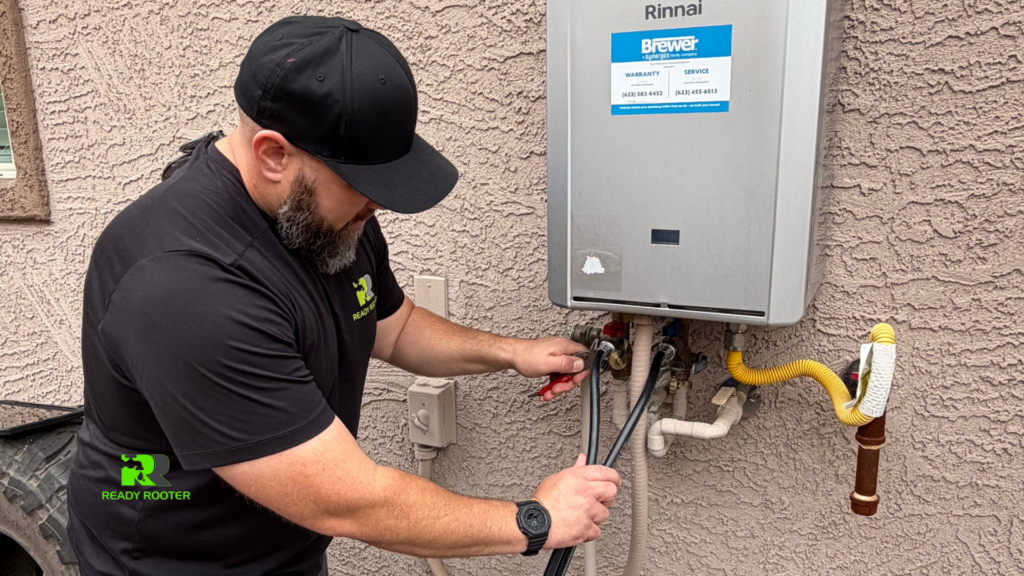
Indoor vs. outdoor installation is another key choice. Many Phoenix-area homes use outdoor gas tankless units mounted on an exterior wall near the main water line. Outdoor units eliminate the need for complex venting runs, free up indoor space, and avoid introducing combustion byproducts inside the home. Arizona’s mild winters mean outdoor units do not face serious freezing risks most of the year, though freeze protection features are still necessary for the occasional cold snap and are standard on quality models. Indoor installations in garages or utility rooms remain common too, particularly in homes where HOA rules restrict exterior-mounted equipment or where wall space is limited.
There is also a distinction between whole-home tankless systems, which are sized to handle all the hot water demands of an entire household, and point-of-use units designed for a single fixture or small zone. A whole-home gas unit might serve a four-bathroom Gilbert home, while a compact electric point-of-use model might handle instant hot water for a wet bar or remote bathroom. Understanding which configuration fits your home is the first step toward understanding the costs and benefits specific to Arizona’s climate and utilities.
Is a Tankless Water Heater Worth It in Arizona? (The Quick Answer)
For most Phoenix-metro families, a tankless water heater is a smart long-term investment-especially when replacing an older, failing tank with a properly sized gas tankless unit. However, it is not a universal upgrade. The decision hinges on a handful of Arizona-specific factors: your energy prices, your home’s hard water situation, household size, hot water usage patterns, and how long you plan to stay.
When a Tankless Water Heater Makes Sense in Arizona
A tankless water heater is typically worth the investment in the following scenarios:
Household of 3–6 people with frequent showers, laundry loads, and a dishwasher running daily. Larger families benefit most from continuous hot water and the energy savings that come with eliminating standby heat loss.
Home with natural gas already available and a gas tank water heater that is 8–15 years old and nearing the end of its life. The incremental cost to upgrade to tankless is lower when you are already replacing a failing unit.
Homeowners planning to stay at least 7–10 years, giving enough time for monthly energy savings to offset the higher upfront cost and begin generating a return.
Limited garage or utility space where reclaiming the footprint of a bulky 50-gallon tank matters-tankless water heaters take up less space than traditional models, mounting flat on a wall.
Families frustrated with running out of hot water, especially those with teenagers taking back-to-back showers. Tankless models provide continuous hot water on demand, eliminating the waiting that comes with a drained tank.
Homes with solar PV systems that can offset some or all of the electricity used by the unit’s controls or, in the case of electric tankless, the heating elements during peak solar production hours.
Arizona’s brutal summers already push utility bills high because of air conditioning demand. Making heating water more efficient is one of the few areas where homeowners can meaningfully save energy without sacrificing comfort, especially when they partner with a Valley-wide plumbing company serving cities across Arizona that understands local utility rates and home layouts. That efficiency gain matters more here than in milder climates.
When a Tankless Water Heater Might Not Be Worth It Here
There are clear situations where the numbers do not favor a tankless upgrade:
Small condos or homes with 1–2 residents and low hot water usage. Tankless water heaters can reduce energy consumption by 24% to 34% for homes that use 41 gallons per day or less, but when total consumption is already minimal, the dollar savings may be too small to justify the upfront premium.
Homeowners planning to move within 3–5 years. The typical payback period stretches beyond that window, and while tankless can add some resale appeal, it rarely recoups the full investment that quickly.
All-electric homes without panel capacity and no budget or desire to upgrade electrical service. A whole-home electric tankless unit demands substantial amperage that older panels often cannot deliver.
Very tight replacement budgets where the primary concern is getting hot water flowing again as cheaply as possible. A standard tank replacement costs significantly less up front.
Many older homes in Phoenix, Tempe, and Central Phoenix neighborhoods built before roughly 1990 may also need gas line upsizing or venting modifications to accommodate a tankless unit, which is why working with reliable plumbing services in Chandler and nearby cities helps ensure those upgrades are done correctly. Tankless water heaters can require larger gas lines or electrical service for installation, and those upgrades add to the total project cost, potentially stretching payback beyond what makes financial sense for some homeowners.
With those general guidelines established, let’s look at how Arizona’s unique climate, water quality, and construction styles change the tankless equation in specific and measurable ways.
Arizona-Specific Pros and Cons of Tankless Water Heaters
Most tankless water heater advice online applies to the entire country. Arizona is not most of the country. The combination of extreme heat, exceptionally hard water, and specific home layouts means the benefits and drawbacks shift in ways that matter for your decision.
Benefits of Tankless in the Phoenix Metro Climate
Energy savings are real-and amplified by Arizona’s climate. Tankless water heaters can be up to 34% more efficient than conventional tank water heaters, according to U.S. Department of Energy data. In the Phoenix metro, those savings lean toward the higher end during summer months because incoming groundwater temperatures regularly exceed 80°F. The unit needs to raise the water temperature only 35–40°F instead of the 60°F rise required in colder climates, meaning less gas or electricity per gallon. At current Phoenix-area natural gas rates of approximately $0.37 per therm, a family of four switching from a standard gas tank to a high-efficiency gas tankless unit can expect to save roughly $100–$150 per year in lower operating costs on gas alone.
Endless hot water for large families. Traditional tank water heaters store a finite supply. When three teenagers shower in sequence on a winter morning-when inlet water drops to around 55–60°F and the tank recovery rate slows-the fourth person gets a cold surprise. A properly sized tankless unit delivers all the hot water your household needs, regardless of how many showers, washing machine cycles, or dishwasher loads run consecutively.
Space savings in common Arizona home layouts. Tank water heaters occupy 10–16 square feet of floor space in garages, side yards, or laundry closets. A wall-mounted tankless unit frees that space for storage, a workbench, or simply less clutter. In smaller Arizona homes and townhomes, this is a meaningful quality-of-life improvement.
Reduced unwanted heat gain. A 50-gallon tank sitting in a Phoenix garage at 115°F is radiating heat into an already-hot space-and potentially into the house. Tankless units mounted outdoors or on an exterior wall eliminate that standby heat load, helping your AC system work a little less hard during the months when every degree matters.
Solar compatibility. Homeowners with rooftop solar PV can pair their system with an electric tankless model or offset the small electrical draw of a gas tankless unit’s controls and ignition. As more Valley homes add solar and battery storage, this pairing becomes increasingly practical.
Drawbacks and Limitations in Arizona Homes
Higher upfront cost. A quality whole-home gas tankless installation in Phoenix typically runs $2,500 to $5,500 or more, depending on model selection, gas line condition, and venting requirements. Tankless water heaters cost between $500 and $2,600 to purchase for the equipment alone, and installation costs for tankless water heaters range from $600 to $2,500 for labor. By contrast, a standard tank water heater replacement runs roughly $1,800 to $3,100 installed. That gap of $1,500 to $3,000 is what needs to be recovered through energy savings and longer lifespan.
Capacity limitations with improper sizing. Improperly sized tankless units may struggle to supply hot water for multiple simultaneous demands. If your household regularly runs two showers, a dishwasher, and a washing machine at the same time, you need a unit with sufficient GPM capacity at your winter inlet temperature-not just the summer rating printed on the box. Undersizing is one of the most common installation mistakes in Arizona.
Retrofit complexity in older homes. Homes built before 1990 in Tempe, older sections of Mesa, and Central Phoenix frequently have undersized gas lines (often 1/2″ when a tankless requires 3/4″ or larger) and minimal venting capacity. Upgrades to gas lines, electrical panels, or venting can add $300 to $1,000 or more to the project.
Hard water-the biggest Arizona-specific risk. This factor deserves its own detailed discussion.
Hard Water and Maintenance in Arizona
Arizona’s municipal water supply is among the hardest in the nation. Phoenix city water measures roughly 10–16 grains per gallon (gpg), while areas of Scottsdale can hit 22–25 gpg and Peoria ranges from 13–17 gpg. Anything above 10.5 gpg is classified as “very hard.”
That hardness means mineral deposits-primarily calcium and magnesium-accumulate rapidly inside the narrow passages of a tankless heat exchanger. While traditional water heaters also suffer from scale, their larger internal volume is more forgiving. Tankless units are more sensitive to buildup because the channels water passes through are much smaller, and even a thin layer of scale reduces flow rate, increases energy usage, and forces the unit to work harder to reach set temperatures.
Descaling is needed yearly for tankless water heaters in Arizona-and in the hardest-water areas, every six months is prudent. A proper maintenance visit includes flushing the heat exchanger with a descaling solution, cleaning the water filter (a simple maintenance task but an important one), inspecting inlet screens, and checking venting and gas connections. Neglecting maintenance can void warranties or service plans from most manufacturers, and a scaled-up unit can fail years before its expected lifespan.
The best defense is pairing your tankless unit with a whole-home water softener installed by an Arizona plumbing specialist or a scale inhibitor. Ready Rooter Plumbing and Drain offers water treatment solutions alongside tankless installations, and homeowners who invest in professional water filtration and treatment services typically see their tankless units last several additional years with reduced maintenance frequency. Regular maintenance and water treatment together are the key to making a tankless water heater truly “worth it” in Arizona.
Costs, Savings, and Payback in Arizona
Understanding the full financial picture-upfront investment, monthly savings, and how long it takes to break even-is essential before committing to a tankless water heater in the Phoenix area. This section provides approximate numbers based on current pricing and local utility rates.
Upfront Costs: Equipment and Installation
Here is what Arizona homeowners can expect to pay, fully installed:
Item | Typical Phoenix-Area Range |
|---|---|
Standard 40–50 gallon gas tank replacement | $1,800–$3,100 |
Whole-home gas tankless installation | $2,500–$5,500+ |
Electric tankless installation (whole-home) | $1,200–$2,500 |
Gas line upsizing (if needed) | $300–$1,000+ |
Electrical panel upgrade (if needed for electric) | $500–$1,500+ |
Permitting (Phoenix/Maricopa County) | $50–$200 |
Permitting for tankless water heaters costs between $50 and $200 depending on your municipality and the scope of work. Factors that push costs higher include relocating the unit from indoors to outdoors, long venting runs for indoor gas models, upgrading a gas line from 1/2″ to 3/4″, or adding a condensate drain for condensing tankless water heaters.
Condensing tankless water heaters have a UEF up to 0.96-Navien’s NPE-2 series, for example, has a Uniform Energy Factor of up to .96-making them the most efficient gas option available. Non-condensing models do not require a condensate drain, which simplifies installation but delivers slightly lower efficiency. Navien is the #1 manufacturer of gas tankless water heaters in North America, and their units are among the most commonly installed in the Phoenix market.
Monthly Energy Savings in Arizona Conditions
Monthly operating costs for tankless water heaters range from $0 to $40 depending on fuel type, usage, and whether solar offsets any electricity consumption. For a concrete example:
A Phoenix family of four using natural gas, consuming roughly 200 therms per year for water heating with a traditional tank, pays approximately $74 per year at current Southwest Gas rates of about $0.37 per therm. Switching to a gas tankless unit that delivers 30% energy savings drops consumption to roughly 140 therms and an annual cost of about $52-a savings of approximately $22 per year on gas alone. However, if the existing tank is older and less efficient (common with units 10+ years old in hard water), actual savings can be substantially higher, reaching $100–$150 per year.
For electric tankless, if a household currently spends roughly $600 per year on electric water heating at Phoenix’s average rate of about $0.15 per kWh, a 25–30% reduction from going tankless could save $150–$180 annually. Electric tankless water heaters can be over 98% efficient, but the higher cost of electricity relative to natural gas means the per-dollar savings depend heavily on your specific rate plan and whether time-of-use pricing applies.
Savings vary by family size, fuel type, age and condition of the unit being replaced, and overall hot water usage patterns.
Typical Payback Period for Phoenix-Area Homes
Combining upfront cost with ongoing savings gives these approximate payback scenarios:
Family of 4, gas tank-to-tankless conversion. Additional upfront cost of roughly $2,000–$3,000 over a standard tank replacement. Annual savings of $100–$150. Payback period: approximately 7–10 years, well within the unit’s 20-year expected lifespan.
Small household of 2, moderate hot water usage. Additional upfront cost of $1,500–$2,500. Annual savings of $50–$80. Payback period: 12–15+ years-less compelling unless the homeowner values endless hot water or space savings.
Large family of 5–6 with high demand. Higher savings from eliminating standby loss on a constantly working tank. Payback can shrink to 6–8 years, especially when factoring in the cost of replacing a tank unit twice during the 20-year life of a single tankless.
Beyond the math, there are non-monetary benefits that influence perceived payback: never waiting for hot water to recover, freeing up garage floor space, and potential resale appeal in competitive Phoenix-area neighborhoods.
Maintenance costs for tankless water heaters range from $20 to $350 annually, so factor that into your long-term budget. And while the federal Section 25C tax credit for high-efficiency water heaters expired at the end of 2025, some local utility rebates may still apply for Energy Star certified models-check with Salt River Project or Arizona Public Service at the time you are ready to install.
For most Arizona families, the typical payback falls in the range of 7–10 years when the system is properly sized and maintained.
Choosing the Right Tankless Water Heater for an Arizona Home
Getting the payback and comfort benefits outlined above requires selecting the right unit for your home. An oversized tankless wastes money upfront. An undersized one delivers frustration instead of the instant hot water you expected.
Sizing for Arizona Groundwater and Household Demand
Two numbers determine whether a tankless water heater will satisfy your household: flow rate (measured in gallons per minute, or GPM) and temperature rise (the difference between your cold inlet water and your desired hot water temperature).
In the Phoenix metro, winter inlet water temperatures are typically 55–60°F. To deliver 120°F water, the unit needs a temperature rise of 60–65°F. In summer, inlet water can reach 75–85°F, requiring only a 35–45°F rise-meaning the same unit delivers a higher flow rate when it is hottest outside. Sizing must always be based on winter conditions, when the demand on the unit is greatest.
Here are common Arizona household configurations and approximate sizing needs:
2-bath Tempe condo, 1–2 people: Gas tankless rated at 6–7 GPM, roughly 120,000–140,000 BTU. Adequate for one shower and a faucet simultaneously.
3-bath Gilbert home, family of 4: Gas tankless rated at 8–10 GPM, roughly 160,000–180,000 BTU. Handles two showers and a dishwasher running at the same time.
4-bath home in Chandler, family of 5–6: Gas tankless rated at 10–11 GPM, 180,000–199,000 BTU, or potentially two smaller units in parallel for very high simultaneous demand.
Undersizing leads to lukewarm water when multiple fixtures run at once. Oversizing wastes money on equipment you will never fully utilize. A professional load calculation during an on-site evaluation is the only reliable way to get the sizing right.
Gas vs. Electric Tankless in Arizona
In the Arizona market, the gas-vs.-electric decision often comes down to existing infrastructure:
Gas tankless is the default choice for whole-home use in most post-1990 Phoenix homes. Units offer higher GPM at a given temperature rise, and natural gas remains less expensive per BTU than electricity in Maricopa County. Condensing gas units deliver the highest energy efficiency, with UEF ratings up to 0.96, though they require a condensate drain and may have slightly higher installation costs.
Electric tankless models excel in point-of-use applications-a guest bathroom, a casita, or a kitchen far from the main water heater. Electric tankless heaters can exceed 98% energy efficiency, making them exceptionally efficient at converting power to heat. However, a whole-home electric unit can draw 100–150 amps, which often exceeds the spare capacity of older electrical panels in neighborhoods across Central Phoenix, older Tempe, and pre-2000 Mesa homes.
Propane tankless units serve homeowners in outlying areas like Queen Creek or rural Maricopa County where natural gas pipelines do not reach. Propane costs more per BTU than natural gas, so the payback period extends, but a tankless propane unit still outlasts and outperforms a propane tank heater for households with moderate to high hot water demands.
Indoor vs. Outdoor Installations in Arizona
Outdoor installation pros: Frees indoor or garage space, eliminates the need for complex venting, avoids combustion air concerns, and reduces indoor heat gain in summer. Most major manufacturers offer outdoor-rated models with built-in freeze protection for the occasional cold night.
Outdoor installation cons: Units are exposed to monsoon dust and rain, direct sun (a shade cover or recessed mounting helps), and the rare hard freeze at higher-elevation Valley edges. Security can also be a minor concern with equipment visible on an exterior wall.
Indoor installation pros: Protected from weather, easier to access for maintenance, and sometimes required by HOA rules or lot configurations.
Indoor installation cons: Requires proper venting (stainless steel for non-condensing gas units, PVC for some condensing models), takes up wall space in a garage or utility room, and may add slight noise to interior spaces.
Ready Rooter Plumbing and Drain typically recommends outdoor mounting on an exterior wall for gas tankless units in the Phoenix area when the home layout, HOA rules, and access to gas and water lines allow it. It is the simplest, most cost-effective configuration for most Valley homes.
Installation, Maintenance, and Longevity in Arizona
Professional installation and disciplined ongoing maintenance are what separate a tankless water heater that lasts 20+ years from one that fails at 10. In Arizona’s hard water environment, these are not optional-they are the cost of realizing the full value of your investment.
Professional Installation: What Arizona Homeowners Should Expect
A typical tankless installation from a licensed Arizona plumber follows a clear sequence, and choosing an affordable, top-rated leaky pipe and drain specialist ensures the work is done safely and to code:
On-site evaluation and load calculation. A technician inspects the existing water heater, measures gas line size, checks electrical panel capacity (for electric models), evaluates potential mounting locations, and calculates your household’s GPM requirements based on fixture count and family size.
Permits and code compliance. Permits are pulled with the local municipality-Phoenix, Chandler, Gilbert, Mesa, etc.-and work is performed to current plumbing and mechanical codes, and many common questions about this process are addressed in Arizona-focused plumbing FAQs.
Removal of old equipment. The existing tank is drained, disconnected, and properly disposed of.
Installation of the new tankless unit. This includes mounting the unit, connecting or modifying gas lines, installing venting (for indoor units), connecting water supply lines with isolation valves for future maintenance access, and wiring power and controls.
Testing and walkthrough. The system is tested at multiple fixtures, temperature output is verified, and the homeowner receives instruction on settings and maintenance expectations.
Professional inspections of internal parts are recommended as part of the commissioning process. Always verify that your installer is licensed, insured, and familiar with the specific manufacturer’s requirements-improper installation can void the warranty before you ever use the unit. A straightforward replacement typically takes one day. Relocating the unit, upgrading gas lines, or adding venting may extend the timeline.
Routine Maintenance in a Hard-Water State
Annual maintenance tasks recommended for tankless water heaters in the Phoenix area include:
Descaling/flushing the heat exchanger to remove mineral deposits. This is the single most important maintenance item in Arizona’s hard water conditions.
Cleaning the water filter and inlet screens to ensure unrestricted water flow into the unit.
Inspecting venting and gas connections for corrosion, blockages, or loose fittings.
Checking for error codes and verifying ignition and flame sensor operation.
Some handy homeowners perform the descaling flush themselves using a pump, a bucket, and food-grade white vinegar-especially if isolation valves were installed during the original setup. However, gas connection inspection, venting checks, and internal component evaluation should be left to a licensed plumber.
Neglecting maintenance can void warranties or service plans from virtually every major manufacturer. A unit that goes three or four years without descaling in Phoenix water will have measurably reduced flow, higher energy usage, and a significantly shortened life.
Extending Lifespan with Water Treatment
Installing a whole-home water softener or scale inhibitor is the single most effective step you can take to protect a tankless water heater in Arizona. Softened water dramatically slows mineral buildup inside the heat exchanger, reducing the frequency of required descaling from annually (or more often) to roughly every 18–24 months.
Ready Rooter Plumbing and Drain offers water softeners, filtration systems, and bundled packages that protect not only your tankless water heater but also your fixtures, appliances, and the rest of your home’s plumbing system. Homeowners who pair a tankless unit with proper water treatment routinely see their systems last many years beyond the baseline-pushing well past the 20-year mark with minimal performance degradation. Tankless water heaters typically last over 20 years, and water treatment is how you actually get there in Arizona.
Common Tankless Water Heater Problems in Arizona-and How to Fix Them
Many tankless issues that Phoenix homeowners experience are directly tied to hard water, improper sizing, or rushed installations, and they often show up alongside other warning signs that you need an Arizona rooter service and professional plumber to inspect your system. The good news: most are preventable or fixable without replacing the entire unit.
Fluctuating Water Temperature or “Cold Water Sandwich”
The symptom is familiar: you turn on the shower, get hot water for a few seconds, then a burst of cold, then hot again. This hot-cold-hot pattern is sometimes called a “cold water sandwich,” and it typically occurs with short, intermittent draws-such as turning a faucet off and on quickly.
Likely causes include distance between the tankless unit and the fixture, low-flow fixtures that don’t trigger the flow sensor consistently, or an undersized unit struggling to keep up. Solutions range from adjusting usage habits (letting the water run a moment longer before stepping in), installing a small recirculation system to keep hot water closer to fixtures, or having a plumber evaluate whether the unit’s settings or sizing need adjustment.
Error Codes and Sudden Loss of Hot Water
Tankless units communicate problems through error codes displayed on the control panel. Common codes Arizona homeowners encounter relate to ignition failure, flame sensor issues, or flow sensor problems-often triggered by scale restricting water or gas flow.
Safety-first advice: do not repeatedly reset the unit without understanding what triggered the error, and if you suspect a leak or failure it is wise to contact an emergency plumbing service in the Phoenix East and West Valley for a rapid assessment. For any gas-related or electrical error, turn the unit off and call a professional, ideally a trusted 24-hour emergency plumbing team in the Phoenix area that can diagnose the issue safely. Ready Rooter diagnoses these issues with gas pressure testing, venting inspection, and internal component checks to identify the root cause rather than just clearing the code.
Scale Buildup and Reduced Flow
If your hot water flow rate has noticeably declined, or the unit is louder than it used to be, scale buildup inside the heat exchanger is the most likely culprit, though severe drain or line obstructions may call for high-powered hydro jetting to clear buildup. Arizona’s hard water can narrow the internal passages enough to reduce GPM by 20–30% within two to three years if no maintenance is performed.
The fix is professional descaling and, going forward, installing a pre-filter or water softener to prevent recurrence. For older tankless units (12–15+ years) with severe scale damage and corroded components, a plumber can help you evaluate whether repair or replacement makes more financial sense, and in some cases a whole-house repipe to replace aging plumbing offers the most long-term value. Tankless water heaters have a lower risk of catastrophic water damage than traditional tank heaters, but a neglected unit can still develop leaks at corroded fittings or a compromised heat exchanger, and sudden failures can resemble the flooding seen with burst pipes that require 24/7 emergency repairs.
Conclusion and Next Steps for Arizona Homeowners
A tankless water heater is worth it for many Arizona homeowners-but “many” is not “all.” The investment pays off when the unit is correctly sized for your household’s hot water demands, professionally installed by a licensed plumber who understands local codes and construction, and maintained on a regular schedule that accounts for the Valley’s notoriously hard water. For budget-conscious homeowners with low hot water usage or plans to move soon, a conventional tank replacement may still be the smarter financial play.
If you are considering making the switch, here are your immediate next steps:
Check the age and condition of your current water heater. If it is 8+ years old and showing signs of rust, leaking, or inconsistent heating, replacement is likely coming soon regardless.
Estimate your household’s hot water usage and think about whether your family is growing, shrinking, or staying the same over the next decade.
Pull your latest gas and electric bills so a plumber can estimate your current water heating costs and project savings.
Schedule an in-home evaluation with Ready Rooter Plumbing and Drain for a side-by-side tankless vs. tank comparison based on your specific home.
You may also want to explore related services: water softeners and filtration to protect your investment against hard water, whole-home repiping if your home still has older galvanized lines, or a camera inspection if you have been dealing with recurring plumbing issues, since hidden sewer problems sometimes require expert sewer repair with same-day help.

Tankless Water Heater FAQs for Arizona Homeowners
How long does a tankless water heater last in Arizona’s hard water? Tankless water heaters can last over 20 years with proper maintenance, including annual descaling and inlet filter cleaning. Without maintenance, Arizona’s hard water can cut that lifespan significantly-sometimes to 10–12 years, which is not much better than a traditional tank.
Can a tankless water heater handle back-to-back showers for a family of five? Yes, as long as the unit is properly sized for your household’s flow rate and winter inlet temperature. A gas tankless rated at 9–11 GPM at a 60°F temperature rise will supply continuous hot water through consecutive showers without the recovery time that limits conventional tank water heaters.
Do I need a water softener with a tankless water heater in Phoenix? It is strongly recommended. Phoenix-area water hardness ranges from about 10 to 25 grains per gallon depending on your city and neighborhood. A water softener protects the heat exchanger from mineral deposits, reduces maintenance frequency, and helps ensure the unit reaches its full 20-year lifespan.
Will a tankless water heater work during a power outage? Gas tankless units require a small amount of electricity for their control board, ignition system, and flow sensor-so they will not operate during a power outage without a backup power source like a battery or generator. Electric tankless units will not function at all without grid power unless the home has battery storage or a generator.
How long does installation take, and will I be without hot water? A straightforward tank-to-tankless conversion typically takes one day-usually 4 to 8 hours. You will be without hot water during the installation itself, but your system will be up and running by the end of the day. More complex projects involving gas line upgrades or relocating the unit may extend into a second day.
Is a tankless water heater compatible with my existing plumbing in a 1980s Arizona home? Often yes, but with modifications. Many 1980s homes have smaller gas lines and may lack the venting configuration a gas tankless unit requires. A licensed Phoenix-area plumber can evaluate your gas line size, electrical panel, and plumbing layout during an on-site assessment and let you know exactly what upgrades are needed.
Does Ready Rooter offer financing or discounts on tankless installs? Ready Rooter Plumbing and Drain offers options to help homeowners manage the cost of tankless water heater installation. Contact the team directly for current financing plans, veteran discounts, senior discounts, or seasonal promotions available in the Phoenix metro area.
Are there any tax credits or rebates available for tankless water heaters in Arizona? The federal Section 25C tax credit for high-efficiency water heaters expired at the end of 2025. However, local utility programs through Salt River Project or Arizona Public Service may offer rebates for Energy Star certified models-check with your provider at the time of purchase for the most current programs.


